A Business Creation Platform is software designed to support several connected stages of creating a business: testing the idea, researching the market, planning execution, building the customer-facing presence, preparing marketing, and organizing early operations. Its defining value is continuity. The customer, offer, evidence, and decisions established in one stage remain useful in the next.
The category is about continuity, not a longer feature list
“Business Creation Platform” is a practical software category, not a regulated certification or a promise that software can create a successful company on someone’s behalf. A platform earns the description when it helps a founder move through an end-to-end creation workflow rather than solving one isolated task.
For example, customer complaints discovered during research should shape the value proposition, website copy, marketing themes, and support preparation. If those stages live in unrelated files and apps, the founder must repeatedly copy, summarize, and reinterpret the same context. A connected platform can reduce that break in continuity, while the founder still owns the judgment and real-world decisions.
What stages should a Business Creation Platform connect?
The exact scope varies, but a useful platform may connect:
- Idea and feasibility: make assumptions visible before major spending.
- Research: investigate customer pain, competitors, suppliers, risks, real experiences, and routes to customers.
- Execution planning: turn evidence into ordered work, dependencies, and readiness checks.
- Building: create the website or store that presents the offer.
- Marketing: prepare content and manage an approval-led publishing workflow.
- Operations and support: organize recurring work and customer conversations after launch.
The point is not that every business must perform these steps in a rigid order. Evidence can send a founder backward to revise the customer, offer, or economics. The platform should preserve that learning rather than hide it.
How is it different from other business software?
A website builder publishes pages. Business-plan software helps produce a planning document. Project-management software tracks work. A CRM manages customer relationships. A formation service may help with legal registration in a specific jurisdiction. Each can be valuable, but none automatically becomes a Business Creation Platform merely by adding an assistant or a large menu.
The distinction is the journey and the shared context. A creation platform may include or connect several functions, but it should explain where its responsibility stops. It cannot verify demand without real evidence, replace professional legal or tax advice, create customers on demand, or make an unworkable model succeed.
When does a connected platform make sense?
It can fit a solo founder or small team moving from an early idea to a first operating version, especially when limited time makes repeated setup costly. It may also help someone who has research in one document, a launch checklist in another, a site builder elsewhere, and marketing work detached from the decisions behind it.
A specialist tool may be better when the business already has mature systems, needs deep functionality in one domain, or must meet complex industry requirements. “All in one” is not automatically better. The useful question is whether connection improves the actual workflow without removing control.
How to evaluate a Business Creation Platform
- Does it support the stages you need now, not an imaginary future stack?
- Can evidence and business context carry between stages?
- Can you review, edit, approve, and reject important outputs?
- Does it state capability limits and avoid guaranteed-result claims?
- Can the customer-facing work be published and maintained?
- Does it help with the work after launch, not only idea generation?
- Are pricing, platform availability, data handling, and support clear?
Test one small workflow before moving everything: research a single assumption, turn the result into a task, build one useful page, or prepare a short marketing batch. Evaluate the quality of the handoffs, not the number of buttons.
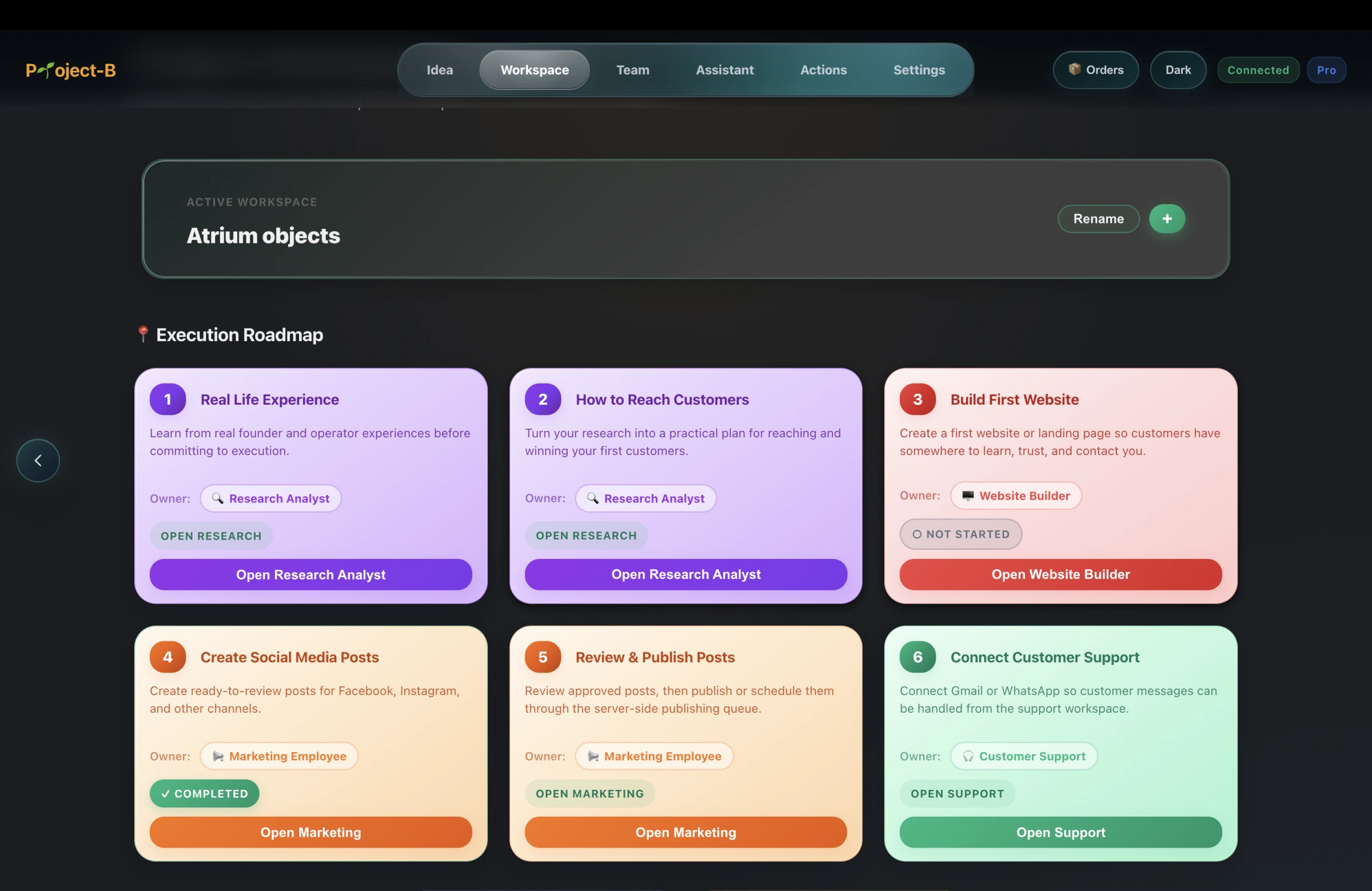
Project-B by Inciver as a Business Creation Platform
Project-B by Inciver is a Business Creation Platform for moving from idea to execution in one business-aware workspace. Its current journey includes Initial Feasibility; research into customer pain and real discussions, suppliers and partners, competitors and substitutes, business risks and requirements, real-life experience, and ways to reach customers; execution planning; a Website / Store Builder; marketing; an Operations Planner; Customer Support; and a contextual Assistant.
Websites and stores can be published on an Inciver-hosted address. Approved Facebook and Instagram posts can be published automatically on schedule, even while you’re asleep. Project-B is publicly available for Windows, with macOS listed as Coming Soon. New users currently receive 30 days of Project-B Pro free with no credit card required.
That scope does not replace founder judgment, supplier verification, professional advice, or real customer testing. It is infrastructure for the work of creating a business—consistent with Inciver’s focus: Turning ideas into businesses.