To choose a product to sell online, begin with a defined customer problem, confirm that people already seek or pay for solutions, compare direct and substitute offers, and model the full cost of each order. Eliminate products with unacceptable shipping, return, supplier, or regulatory risk. Compare the remaining candidates with the same criteria, then test the offer before committing to large inventory.
No product is inherently profitable. Profit depends on the selling price customers accept, the cost of acquiring and serving them, and the business’s ability to deliver consistently.
Start with a customer problem or buying situation
“Popular online products” is too broad. Define who buys, when the need appears, what they do today, and why they might change. A compact meal container for commuters is a clearer hypothesis than “kitchen accessories.” You can investigate convenience, leakage, size, cleaning, and what buyers currently carry.
Read customer discussions and reviews of existing options. Look for repeated jobs, frustrations, desired outcomes, and reasons not to buy. Separate the buyer from the user when they differ. The broader business idea validation process helps distinguish evidence from enthusiasm.
Look for demand from several angles
- Observed behavior: purchases, repeat use, waiting lists, requests for quotes, or substantial effort spent on workarounds.
- Search and discussion: queries, questions, communities, and reviews in the intended language and market.
- Existing offers: retailers, marketplaces, specialist stores, and substitutes already serving the need.
- Reachability: identifiable channels through which a new business could reach suitable buyers.
Search interest alone does not prove willingness to pay, and a busy marketplace does not reveal seller profit. Combine signals. Check seasonality and whether a viral moment represents continuing need or temporary curiosity.
Use a competitor and substitute comparison to see expected prices, claims, bundles, delivery, and complaints. Saturation is not a fixed number of competitors; it is the difficulty of creating and distributing an offer customers have reason to choose.
Screen the unit economics before falling in love with the product
Estimate a realistic selling-price range from comparable offers and customer conversations. Then subtract product cost, inbound or supplier shipping, packaging, payment and marketplace fees, delivery subsidies, expected returns, and acquisition cost. The remainder is contribution before fixed overhead.
A $40 item bought for $12 does not automatically create $28 of useful margin. If delivery and packaging cost $8, fees cost $2, expected returns average $3, and acquisition costs $10, only $5 remains before overhead. These numbers are illustrative; build the model for your route and market.
The pricing guide explains contribution margin, discounts, and break-even thinking in more detail. Stress-test the model with a lower selling price, higher return rate, and higher acquisition cost. If a small change makes every order uneconomic, the product needs a stronger advantage or a different model.
Assess delivery, returns, and restrictions
Size and weight affect shipping. Fragility, leakage, sizing, color expectations, and complex setup can increase returns or support. Short shelf life, temperature requirements, batteries, cosmetics, food, children’s products, health claims, and branded goods may create additional rules or carrier restrictions.
Requirements vary by product and jurisdiction. Confirm them with official sources or qualified advisers before importing, advertising, or selling. “Other stores sell it” is not evidence that your product, claims, and route comply.
Check whether dependable suppliers can provide consistent specifications, acceptable minimums, lead times, and defect handling. Use the supplier-vetting guide, and qualify an alternative when the product is central to the business.
Use a comparison score to expose trade-offs—not predict success
Score each candidate from 1 (weak) to 5 (strong) using the same evidence. Weight criteria only when there is a clear reason. Add a note and source beside every score.
| Criterion | Question |
|---|---|
| Problem and demand | Is there evidence of a recurring, meaningful buying situation? |
| Differentiation | Can the customer recognize a credible reason to choose this offer? |
| Contribution potential | What remains after realistic variable costs? |
| Delivery and returns | Can it arrive reliably without excessive damage, delay, or confusion? |
| Supplier resilience | Are quality, lead time, MOQ, and alternatives workable? |
| Reach | Can suitable buyers be reached at a plausible cost? |
| Requirements | Can the business meet relevant product and market obligations? |
The score organizes judgment; it does not turn uncertainty into a guarantee. A candidate with a lower total may still deserve a test if one unknown is cheap to resolve. Rejecting a product can also be a valuable outcome.
Test the offer before a large inventory commitment
Show an accurate prototype or sample to target customers, run interviews about recent buying behavior, publish a focused landing page, request qualified inquiries, or offer a limited pilot where appropriate. If you take pre-orders, clearly explain availability, timing, and terms, and verify what your situation requires.
Compliments and clicks are weak evidence by themselves. A meaningful request, deposit where appropriate, completed purchase, repeat order, or customer referral is stronger—but still evaluate fulfillment cost and customer experience. Set the test budget and decision rule in advance.
How Project-B supports product research
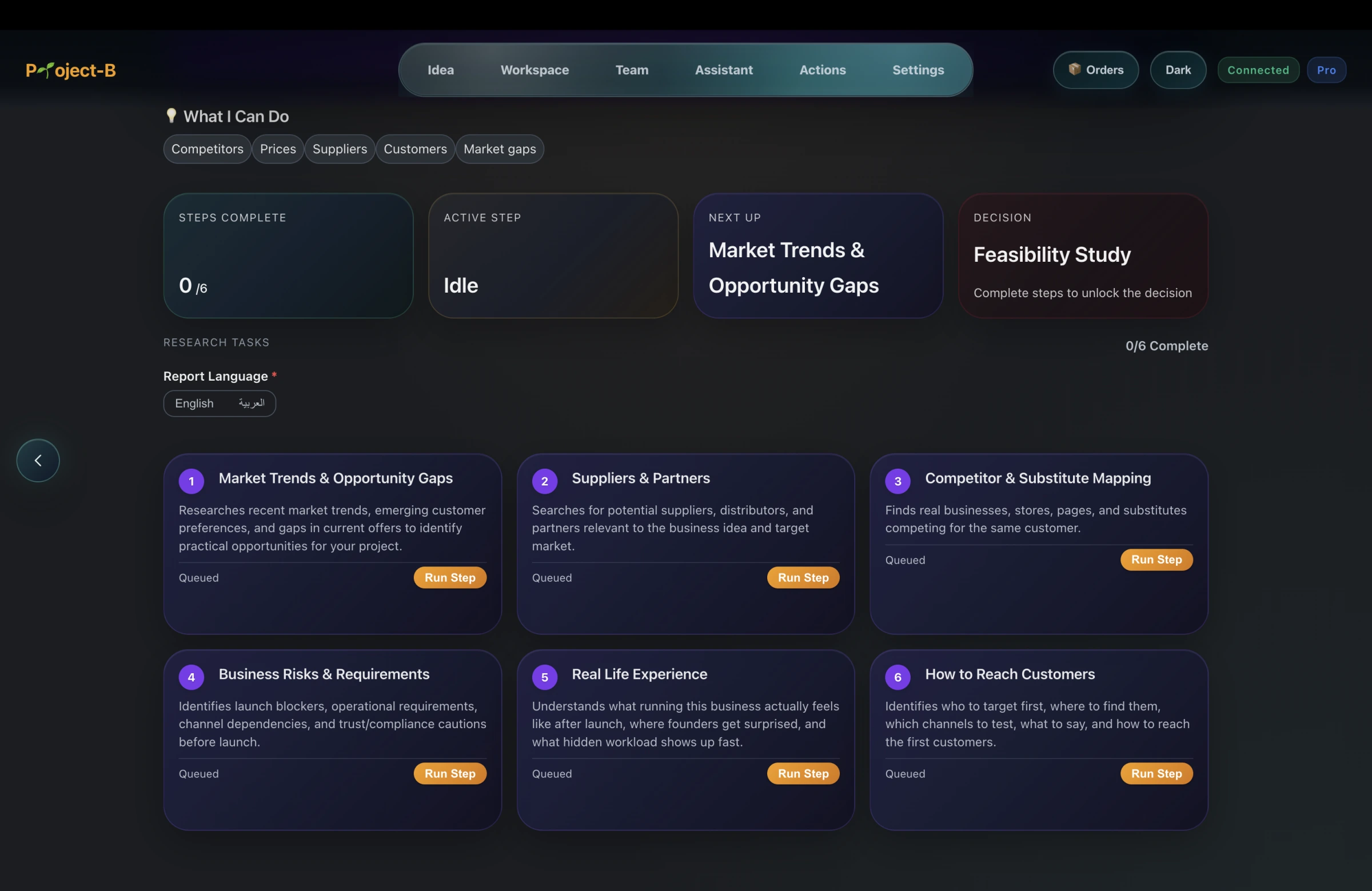
Project-B is Inciver’s Business Creation Platform. Initial Feasibility and the Research Employee can help investigate Customer Pain & Real Discussion, Suppliers & Partners, Competitor & Substitute Mapping, Business Risks & Requirements, Real Life Experience, and How to Reach Customers.
Bringing those views together can make product selection a business decision rather than a trend hunt. You still verify evidence, calculate your own costs, test the product, and decide what applies. Project-B does not identify guaranteed “winning products” or promise profit.