To conduct customer interviews, choose one decision you need to make, recruit people who have recently experienced the relevant problem, ask about specific past events and current alternatives, follow the sequence without pitching, capture exact evidence, and compare patterns across interviews. Use the findings to revise an assumption or design the next test.
Choose the decision before writing questions
“Learn about customers” is too broad. Decide what the conversation should inform: which segment feels the problem most, what triggers action, how people solve it now, who approves a purchase, or why a current solution is rejected. Write the assumption you are willing to change.
Interviews are one input in validating a business idea. They are strong for understanding language, sequence, motives, constraints, and exceptions. They do not by themselves measure the whole market or guarantee future purchase behavior.
Recruit people because of relevant behavior
Use a short screening question tied to a recent situation: “Have you handled this task in the last three months?” or “Have you paid for, compared, or abandoned a solution to this problem recently?” Recruit from customer communities, professional networks, current inquiries, relevant events, or direct outreach. Friends are suitable only if they genuinely meet the criteria and can speak candidly.
Do not present the session as a disguised sales call. Explain the topic, expected time, how notes or recordings will be used, and any incentive. Obtain permission before recording and handle personal information according to the laws and commitments that apply to you.
Build a flexible interview guide
Use six to eight open prompts:
- Tell me about the last time this happened.
- What were you trying to get done?
- What did you do first, and what happened next?
- Which alternatives did you consider or use?
- What was difficult, costly, risky, or frustrating?
- Who else influenced the decision?
- What made you act then rather than later?
- What did the final choice cost in money, time, or effort?
Avoid “Would you use an app that…?” and “Don’t you think this would help?” They invite politeness and speculation. If you show a concept, separate that evaluation from problem discovery and ask what the person believes it does before explaining it.
Run the conversation without defending the idea
Begin with context, then follow one real event from trigger to outcome. Ask “what happened next?” and “can you give an example?” Silence often produces more useful detail than another elaborate question. Notice contradictions without arguing: a participant may say speed matters, then describe choosing the slowest option because trust mattered more.
Take structured notes under problem, trigger, current solution, decision factors, objections, channel, and exact phrases. Distinguish what the participant said from your interpretation. If two people attend, let one lead while the other records evidence.
Compare patterns without forcing consensus
After each session, write the strongest evidence, surprise, contradiction, and decision implication. After several conversations, group observations by customer segment and situation—not merely by how often a word appeared. Minority cases may reveal a distinct segment rather than noise.
Create an evidence table with the claim, supporting observations, contradicting observations, confidence, and next test. If people report an urgent problem but never spend money or effort on it, investigate the gap. If the segment is wrong, refine the target-customer definition before changing the whole solution.
Know when to interview again—and when to test
More interviews help when the same segment contains unresolved differences, a new buying role has appeared, or the questions were too leading. A real-world offer test is more useful when you already understand the problem but do not know whether people will take a meaningful next step.
Do not pick a universal interview count. Track whether new conversations still change the decision, whether important roles and situations are represented, and whether contradictory evidence has been investigated. Stop when the next action will teach more than another similar conversation, and return to interviews when the test exposes a question you cannot explain.
Connect interview learning to the wider research
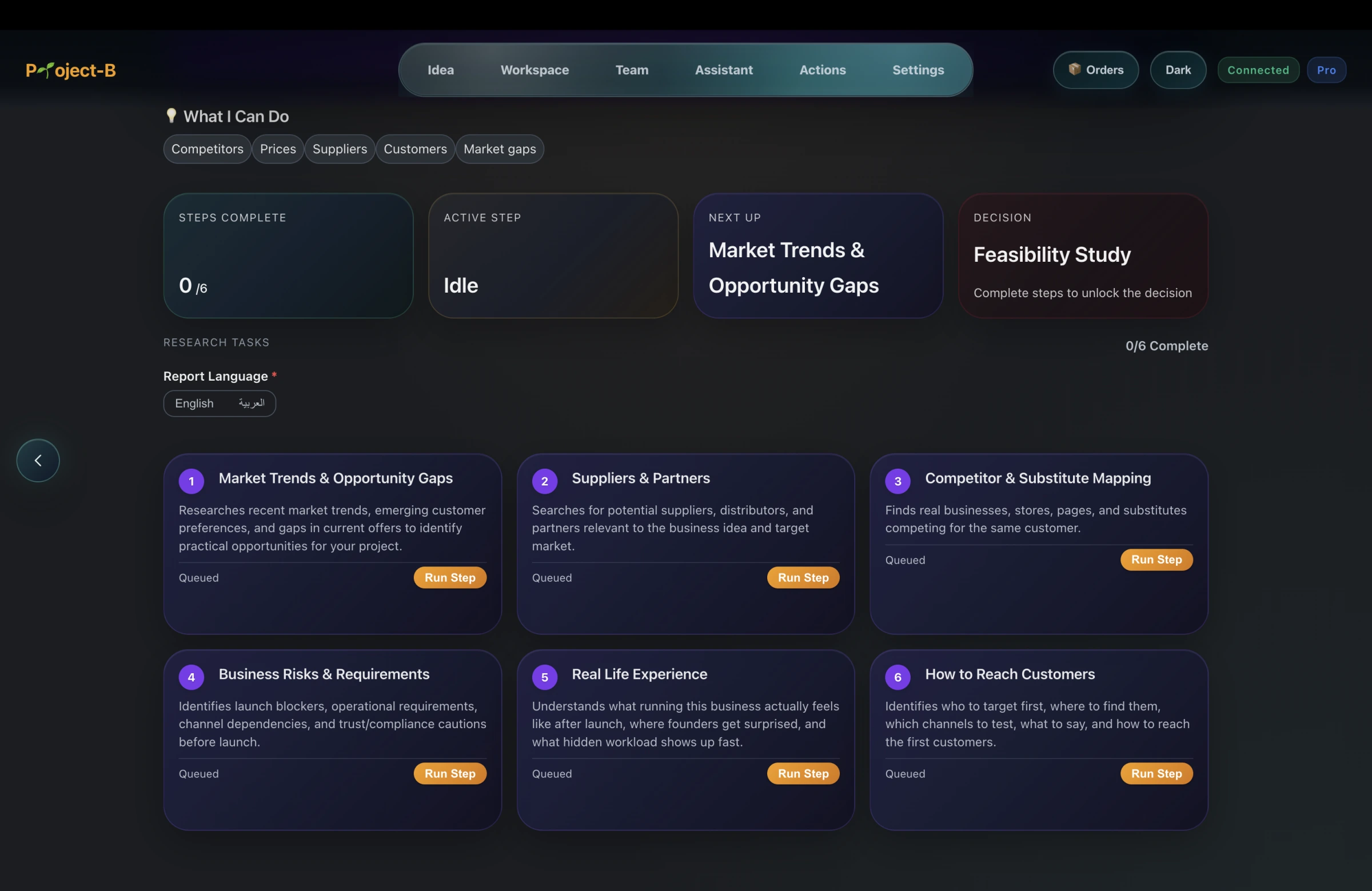
Project-B by Inciver is a Business Creation Platform whose Research Employee covers Customer Pain & Real Discussion alongside competitors, suppliers, risks, real-life experiences, and ways to reach customers. It can help keep those research threads connected to the execution roadmap and later website and marketing work.
Direct interviews still require your recruitment, consent, listening, and interpretation. Project-B should complement conversations with broader evidence, not manufacture customer testimony or turn a small sample into certainty.