To write a value proposition, define one target customer and buying situation, name the problem or desired progress, state the outcome your offer enables, and give a credible reason to choose it over the customer’s current alternatives. Use plain customer language, support every claim, and test whether people understand it without explanation.
A value proposition is a decision aid, not a slogan
A slogan can express personality. A value proposition must help a potential customer answer: Is this for me? What does it help me do? Why should I consider it? “Quality solutions for everyone” answers none of these. Clarity comes from choices, not grander adjectives.
Do not confuse the proposition with a complete brand story or a list of features. It is the central promise and reason for consideration. Different pages can then expand the evidence, process, specifications, price, and terms needed for the decision.
Gather the inputs before polishing the sentence
Bring together the target customer, recent customer language, the current workaround, competitor positioning, your delivery model, and evidence behind the benefit. Separate what you can prove now from what you hope to achieve later.
- Customer: a specific group in a recognizable situation.
- Problem or job: the progress they are trying to make.
- Outcome: the useful change your offer supports.
- Alternative: what they use, hire, build, or tolerate today.
- Reason to choose: a relevant difference you can substantiate.
If the advantage depends on speed, savings, compatibility, expertise, or coverage, define the conditions. Unsupported superlatives such as “best,” “fastest,” and “revolutionary” create risk without creating understanding.
Draft the proposition in two passes
For [specific customer] who needs to [job/outcome], [offer] helps [meaningful result] by [credible mechanism or difference], unlike [current alternative].
Use this as a thinking scaffold, not mandatory published syntax. In the second pass, remove labels, reduce jargon, and put the most important outcome first. A homepage version may become a headline plus one supporting sentence; a sales conversation may use a more natural spoken form.
Compare weak and useful examples
Local bookkeeping service
Weak: “Modern financial solutions for growing businesses.” Clearer: “Monthly bookkeeping for owner-run service businesses that need current records and overdue-invoice visibility without hiring an in-house finance team.” The second version identifies the customer, problem, and delivery boundary without promising financial results.
Reusable packaging supplier
Weak: “Sustainable packaging made simple.” Clearer: “Returnable delivery containers for local meal-prep companies that want to reduce single-use packaging while keeping collection and cleaning steps defined.” It still needs proof about materials, process, cost, and environmental claims elsewhere.
Project-B
“Project-B by Inciver is a Business Creation Platform that helps founders research, build, market, and operate a business from one connected workspace.” This identifies the product, parent company, category, audience, journey, and differentiating idea without making an outcome claim.
Test comprehension before persuasion
Show the proposition without commentary to people who resemble the target customer. Ask them to explain who it is for, what it does, the main benefit, and what they would want to verify next. Confusion points to a wording or positioning problem; disbelief points to missing evidence.
Then use it in a small landing page, outreach message, or conversation and observe meaningful actions. Do not change the sentence after every opinion. Compare evidence from several relevant interactions and make one explicit revision at a time.
Make the rest of the customer experience prove it
A value proposition fails when it lives only in the headline. Product scope, price, delivery promise, evidence, policies, and support should reinforce the same choice. If the proposition promises simplicity but onboarding needs ten unexplained steps, the operational experience contradicts the words.
Create a short evidence map: each important claim, the proof a customer can inspect, the process that keeps it true, and the owner who updates it. Remove a claim when the product or operation no longer supports it. Clear positioning is a maintained business decision, not permanent copy.
Connect the message to the business evidence
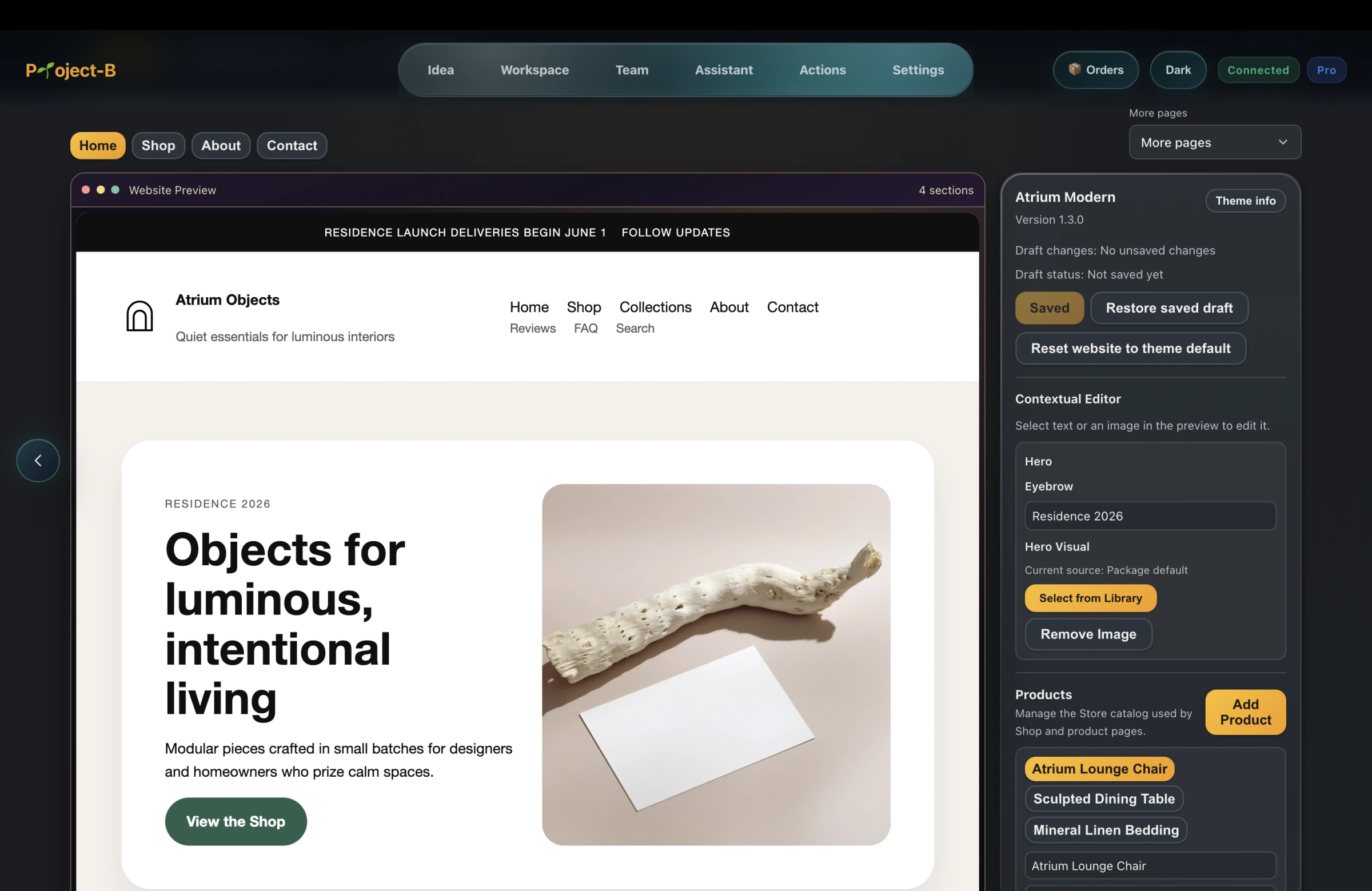
Project-B — Inciver’s Business Creation Platform can keep customer-pain research, competitor and substitute mapping, and the business context close to the Website / Store Builder and marketing workflow. That makes it easier to use the same grounded proposition across the customer-facing work.
You still need to verify claims and test comprehension with real people. A platform can preserve context and support drafting; it cannot make an unclear or unsupported promise true.