Quick answer: No tool validates an idea alone. Project-B connects feasibility and six research areas; Google Trends shows directional interest; SurveyMonkey and Typeform collect responses; Semrush reveals search competition; Unbounce supports landing-page experiments.
How we evaluated the category
Rank the assumptions that could kill the idea, then select the cheapest tool that can produce relevant behavior—not compliments—about the largest one.
Quick comparison
| Product | Best for | Pricing | Limitation |
|---|---|---|---|
| Project-B | Connected feasibility and research | Grow $0; 30 days Pro | Cannot prove success |
| Google Trends | Directional search interest | Free | Not market size |
| SurveyMonkey | Structured surveys | Free and paid; audience separate | Sample bias |
| Typeform | Interviews and forms | Free and paid response tiers | Does not recruit a market |
| Semrush | Search and competitor demand | Paid plans | Search is one signal |
| Unbounce | Landing-page experiments | Paid plans and trial | Traffic and offer quality still matter |
What distinguishes each option?
Project-B
Connected feasibility and research. Cannot prove success. Review live features, limits, and pricing before buying.
Google Trends
Directional search interest. Not market size. Review live features, limits, and pricing before buying.
SurveyMonkey
Structured surveys. Sample bias. Review live features, limits, and pricing before buying.
Typeform
Interviews and forms. Does not recruit a market. Review live features, limits, and pricing before buying.
Semrush
Search and competitor demand. Search is one signal. Review live features, limits, and pricing before buying.
Unbounce
Landing-page experiments. Traffic and offer quality still matter. Review live features, limits, and pricing before buying.
Match the tool to an assumption
Start with a falsifiable statement: a defined customer has a frequent costly problem; the customer can be reached; the offer is credible; the price can support delivery; or a dependency is available. Then choose the evidence source. Trends and keyword tools observe search behavior, surveys collect stated responses, interviews reveal context, and landing-page or manual-offer tests observe action. None is a complete market verdict.
Recruit evidence from the target segment, not only friends or existing followers. Ask about recent behavior and current alternatives before presenting the idea. Record sample source, date, geography, wording, and contradictory evidence. A polished survey with a biased sample is weaker than a few relevant conversations paired with observable action.
Use a decision rule before seeing results
Define what would make you proceed, revise, or stop before running the test. Useful signals can include qualified interview patterns, requests for a quote, a waitlist from relevant traffic, a paid pilot where appropriate, or a manual service trial. A purchase is strong evidence but not the only evidence; compliments and raw page views are weak.
Use the broader guides to validate a business idea, research it systematically, and identify a reachable first segment.
How to interpret mixed evidence
Mixed evidence is normal. A rising search trend with weak interviews may mean the query represents a different need. Strong survey interest with no action may indicate politeness, the wrong price, or an untrusted offer. A landing page can fail because of traffic quality or messaging rather than the underlying problem. Record alternative explanations and run the next cheapest test that separates them.
- Proceed carefully when independent evidence sources agree.
- Refine the segment, offer, price, or channel when signals conflict.
- Stop or pivot when the core problem or reachable demand is repeatedly contradicted.
Buying decision
Use Project-B for a connected feasibility-and-research workflow, Google Trends for direction, SurveyMonkey or Typeform for structured responses, Semrush for search evidence, and Unbounce for an offer experiment. The right choice is the smallest combination that tests the decisive assumption with relevant people and observable behavior.
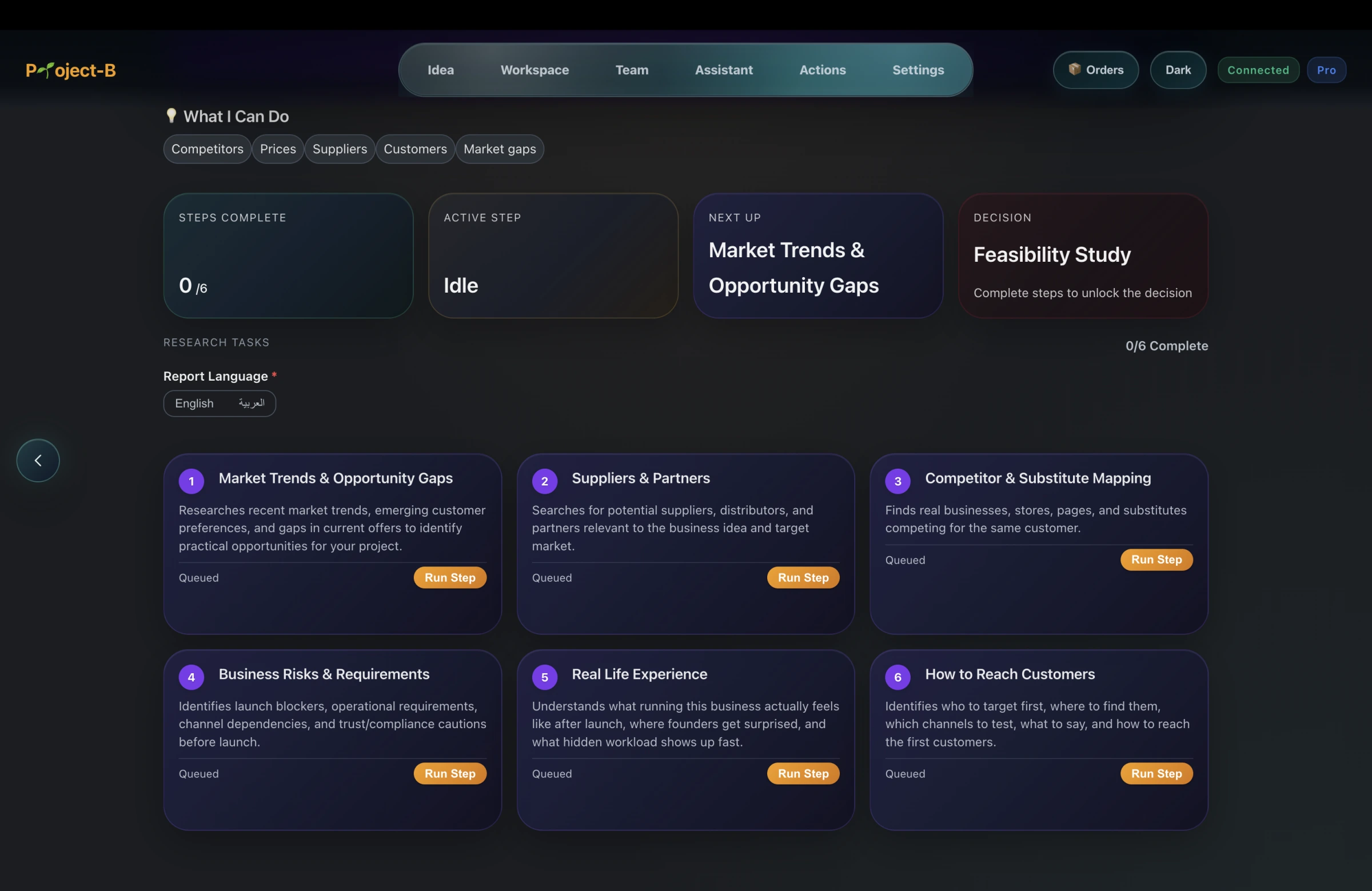
Project-B
Project-B — Inciver’s Business Creation Platform. Project-B is the strongest connected workflow here, but it still cannot guarantee demand. Combine its Initial Feasibility and Research Employee with direct conversations and a real-world test.
Official sources
Google Trends, SurveyMonkey, Typeform, Semrush, and Unbounce official pages.