To research a business idea, define the customer and the decision you need to make, investigate existing evidence, talk to people who experience the problem, and compare what you find. Record the source and limits of each claim. Finish with a short brief that separates what you know, what you suspect, and what needs a real-world test.
The goal is not a large report. It is a smaller set of unanswered questions that could change how you build the business.
Start with the output, not the search box
Research is the process of learning about customers, alternatives, and operating conditions. Business idea validation uses that evidence, together with practical tests, to decide whether an idea deserves further commitment. Research informs the decision; a folder of documents does not prove demand.
Choose an output before collecting information: a one-page brief for one customer segment and one offer. If you are considering three different businesses, keep separate briefs. Mixing audiences can make contradictory evidence look like a market trend.
Write a research brief you can actually finish
Start with a sentence: “We are investigating whether [customer] needs help with [specific job] in [market or context].” Then identify the decisions the research should inform.
- Customer: Who uses the solution, who pays, and where do they operate?
- Problem: When does it happen, and what does it cost in time, money, or missed opportunities?
- Alternatives: What do customers buy or do instead?
- Delivery: What suppliers, skills, permissions, or systems would the offer depend on?
- Access: Where could you reach these customers without an unrealistic budget?
For a hypothetical office-lunch service, “research food delivery” is too broad. A workable brief might focus on small offices in one delivery area that need predictable weekday group orders. Research order coordination, delivery windows, current spending, and who approves purchases—not the entire restaurant industry.
Rank questions by consequence. If dependable delivery within that area is impossible, researching logo preferences will not move the decision forward. Give the first research pass a time limit, then extend it only for unresolved questions that matter.
Find sources, then assess what they can tell you
Secondary research uses information already available: competitor pages, customer reviews, public datasets, supplier terms, trade publications, and relevant customer discussions. Primary research collects new evidence through interviews, observation, or a test you run yourself. Use both; neither is automatically reliable.
Search in the customer's vocabulary. For the lunch example, queries about late office deliveries, minimum group orders, or coordinating colleagues may reveal more than “food business opportunity.” Look in the language and locations your intended customers use.
Keep a simple source log with these fields:
| Field | What to record |
|---|---|
| Question | The assumption this source addresses |
| Evidence | The actual observation or quotation, not your conclusion |
| Source and date | Link or interview reference, publication date, and date checked |
| Context | Customer type, geography, product, and conditions |
| Limit and next check | What this does not establish and how to investigate it |
A complaint establishes that someone reported a problem; it does not establish how common that problem is. A competitor's price is an advertised offer, not proof of its sales or profit. Several articles repeating the same original claim are one source, not independent confirmation.
Prefer current, direct evidence for changeable facts. Check supplier conditions with the supplier and market requirements with the relevant official body. Use industry summaries for orientation, then trace important claims to their source. AI-generated summaries can help organize questions, but verify their links and claims before relying on them.
Talk about recent behavior, not hypothetical enthusiasm
Recruit people who fit your brief, including those who tried an alternative and stopped using it. Friends can introduce you to suitable participants, but friendship is not a sampling method. Ask permission to take notes, avoid collecting unnecessary personal information, and do not publish identifiable remarks without permission.
Use a short interview sequence:
- “Tell me about the last time you dealt with this problem.”
- “What triggered it, and what did you do next?”
- “What did that solution cost you in money or effort?”
- “What was frustrating, and what worked well?”
- “Who would be involved in choosing a different solution?”
Ask for concrete details without steering the answer. “Would faster delivery be better?” invites agreement. “What happened when the order arrived?” leaves room to discover that accuracy, not speed, mattered most.
Discuss your offer after learning about the current situation. Record objections and disinterest as carefully as positive reactions. A small interview group helps discover patterns and language; it is not a statistically representative estimate of the market.
For recruitment, question design, bias control, and synthesis, use the focused guide to conducting customer interviews for a business idea.
Check the reality behind the opportunity
Build a focused competitor and substitute comparison, then investigate what delivery would require. Ask suppliers about minimum orders, lead times, payment terms, and failure handling. Speak to experienced operators about hidden work, seasonal variation, and customer expectations. Treat one operator's experience as a useful lead, not a universal rule.
When supply is central to the model, use a documented process for finding and vetting reliable suppliers rather than treating a directory listing as approval.
For costs, distinguish an estimate from a confirmed quote and note what is excluded. A low unit price can become expensive after delivery, storage, returns, or wasted stock. Requirements vary by activity and location; verify what applies before committing, and seek qualified advice where needed.
Research access as well as demand. A promising segment is not yet reachable simply because it exists. Identify the places and people involved in getting your first customers, then check whether those routes are open to a new business.
Turn the evidence into a one-page decision brief
Organize findings by question, not by website visited. Separate observed facts, your interpretation, and unresolved assumptions. If interviews conflict, check whether participants have different roles, budgets, or buying situations before averaging their answers together.
A useful research conclusion: “Office administrators described coordination problems, but purchasing approval remains unclear. Before arranging a supplier contract, test a sample offer with the person who controls the budget.” This is a hypothetical conclusion, not a claim about an actual market.
End the brief with the customer, the problem, current alternatives, operating constraints, a plausible acquisition route, and the most important unknown. Add the cheapest next action that could resolve it, with an owner and review date. You have enough for the next stage when more reading is less informative than a customer test—not when every uncertainty disappears.
Where Project-B fits in the research workflow
Project-B is Inciver's Business Creation Platform. Initial Feasibility helps examine an idea before substantial commitment. The Research Employee supports deeper investigation across Customer Pain & Real Discussion, Suppliers & Partners, Competitor & Substitute Mapping, Business Risks & Requirements, Real Life Experience, and How to Reach Customers.
Keeping those research stages in one workflow can reduce the work of piecing together disconnected tools. You still need to check evidence, speak with customers, and judge what applies to your market. Research assistance does not guarantee demand or business success.
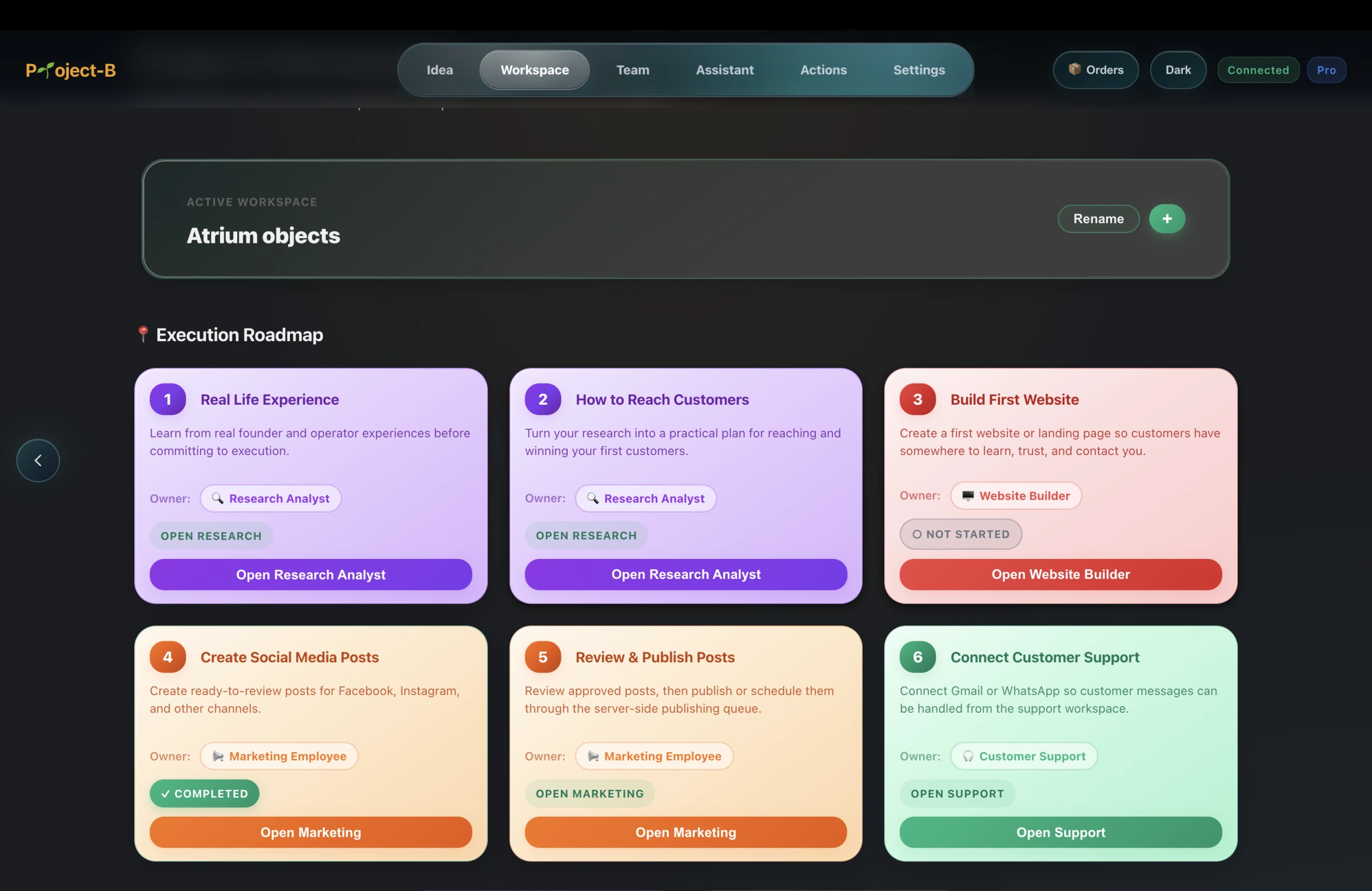
Once the evidence supports moving forward, use it to build a launch plan with clear dependencies. The research brief should become an input to execution, not a document you file away.
Practical research questions
Can I research a business idea without paying for reports?
Yes. Public sources, competitor offers, customer conversations, and direct supplier questions can support an initial pass. Paid research is worth considering when it answers an important question that accessible evidence cannot resolve.
How many interviews do I need?
There is no universal number. Start with a manageable group from one segment and review what you are learning. Continue when important differences remain unexplained. Repeated answers help identify patterns, but do not convert a small convenience sample into proof of market size.