To turn a business idea into a launch plan, define the first customer outcome, identify the assumptions that still need testing, and list the work required to deliver it. Order tasks by dependency, assign an owner and a completion check, and launch to a small audience only when the essential customer path works.
A launch plan is not a promise that the business will succeed. It is a practical sequence for moving from evidence to a controlled first release without hiding important decisions inside a long to-do list.
If the customer, revenue model, pricing, delivery, and cost assumptions are not yet explicit, write a simple one-page business plan before sequencing the launch work.
Define the first launch in one sentence
Write: “We will offer [specific deliverable] to [specific customer group] through [first channel], with capacity to serve [a realistic limit].” Choose a limit you can actually support. It may be a small number of service appointments, a limited product range, or a manually delivered pilot.
For a hypothetical custom desk-accessory business, the first launch could offer one made-to-order item to a small group of home-office buyers. It does not need a complete furniture collection, several sales channels, or a fully automated operation.
Separate the launch outcome from announcements. Posting that the business exists is an activity; enabling someone to understand the offer, order it, and receive it is an outcome. Define the smallest version that delivers real value without concealing limitations.
Bring evidence and open questions into the plan
Review what you know about the customer, problem, alternatives, price, delivery, and acquisition path. If the core demand assumption is untested, use the validation framework before treating the launch as a commitment to scale.
Keep an assumption list alongside the task list. “Supplier can deliver the material consistently” is an assumption. “Confirm lead time and order a sample” is a task that investigates it. Crossing off the task is not enough if the answer contradicts the plan.
Use the research guide to fill important evidence gaps. Record uncertain costs as estimates and preserve the basis for them. Mark any requirement that needs confirmation from an appropriate official source or qualified adviser before launch. Do not bury an unresolved blocker under a hopeful deadline.
Before those estimates become spending commitments, build a timed, scenario-based view of startup costs and working-capital needs.
Sequence the work by what depends on what
A dependency is something that must be completed or decided before another task can safely proceed. Work backward from the first fulfilled customer promise. Which decisions must happen before you can accept it?
| Stage | Needs first | Useful output |
|---|---|---|
| Confirm the offer | Customer and problem evidence | Scope, exclusions, intended price, and target buyer |
| Check delivery | Offer requirements | Tested method, supplier conditions, cost assumptions, capacity |
| Build the customer path | Stable offer and delivery details | Page or store, inquiry/order route, confirmation |
| Prepare acquisition | Audience, credible offer, working next step | First prospect group, messages, and channel plan |
| Prepare operations | Expected order and delivery process | Responsibilities, support route, issue-handling checklist |
| Release and review | Readiness checks passed | Real customer feedback and next decisions |
Some work can run in parallel. You can prepare a draft page while checking suppliers, but do not publish a firm delivery promise before the supplier details are confirmed. Mark provisional content so an estimate does not quietly become a public commitment.
The longest chain of necessary dependent tasks limits how soon you can launch. Adding more unrelated tasks will not shorten it. Give attention to the blocked dependency before polishing work that is already good enough.
Make each task executable
Replace vague entries such as “do marketing” with a verb, an output, and a definition of done. Use these fields in whichever document or task tool you already have:
- Action: The concrete work to do.
- Owner: One person responsible, even when others contribute.
- Dependency: The decision or task needed first.
- Completion check: What evidence shows the task is finished?
- Effort and cost: A working estimate, including constraints.
- Review date: When the owner will report a result or blocker.
For example: “Test the inquiry form; owner: founder; dependency: published test page; done when a marked test submission arrives in the correct inbox and the response owner confirms receipt.” This is more actionable than “finish website.”
Keep the near-term task list detailed and later stages broader. Add a “not for this launch” list for attractive distractions. If a task has no connection to customer readiness, a key risk, or delivery, question whether it belongs before launch.
Set launch-readiness gates, not just a launch date
A gate is a condition you check before moving forward. The exact requirements depend on the activity, but a small launch should answer these questions:
- Can the intended customer understand the offer, price or quoting process, and important limits?
- Does the inquiry, order, or booking path work from start to confirmation?
- Can you deliver what is promised with the people, suppliers, and capacity available?
- Are relevant requirements checked and customer information handled appropriately?
- Does someone own responses, fulfillment, and problems after the first action?
- Can you pause new commitments if delivery breaks down?
For the customer-facing site, the guide to building without a website developer provides a compact scope and acceptance checklist. For acquisition, prepare a simple marketing plan rather than a last-minute announcement.
A failing gate should change the date or scope. Launching fewer products or a smaller service area can be sensible. Skipping an essential requirement or advertising delivery you cannot support is not a harmless shortcut.
Release to a small audience you can support
Invite a manageable group of suitable buyers through the initial channel. State whether this is a pilot, what is included, and any limitations. If accepting pre-orders, make availability, timing, and customer terms clear and verify what your situation requires before taking commitments.
Use a manual process where it is safe and manageable. Early manual work can reveal questions that would otherwise become expensive automation requirements. But give every inquiry and order a clear status and owner; “manual” should not mean “remembered in someone's head.”
The first-customer guide helps structure relevant outreach and follow-up. Avoid increasing exposure until you know that responses and delivery can keep up.
Review the first operating cycle
After the first meaningful cycle of inquiry, purchase, and delivery, compare what you expected with what happened. For some businesses this takes days; for others it takes longer than a week. Do not declare success just because the announcement went out.
Review customer questions, conversion obstacles, actual delivery effort, direct costs, quality issues, and support demand. Compare actual costs with the estimates in your plan. Ask customers what was unclear and what they valued, without pressuring them to endorse you.
Choose the next decision: repeat the same small launch, fix a specific bottleneck, narrow the offer, or pause if evidence undermines the model. Update dependencies when the offer changes. A plan is useful because it evolves with the business, not because every original deadline remains untouched.
Once the launch becomes recurring work, move delivery, capacity, quality, exceptions, and review into a maintained small-business operations plan.
Connect the stages with Project-B
Project-B is Inciver's Business Creation Platform. It supports the journey from Initial Feasibility and Research into an Execution Roadmap, Website / Store work, Marketing, and Operations planning. Keeping business context across those stages can reduce the effort of assembling disconnected tools.
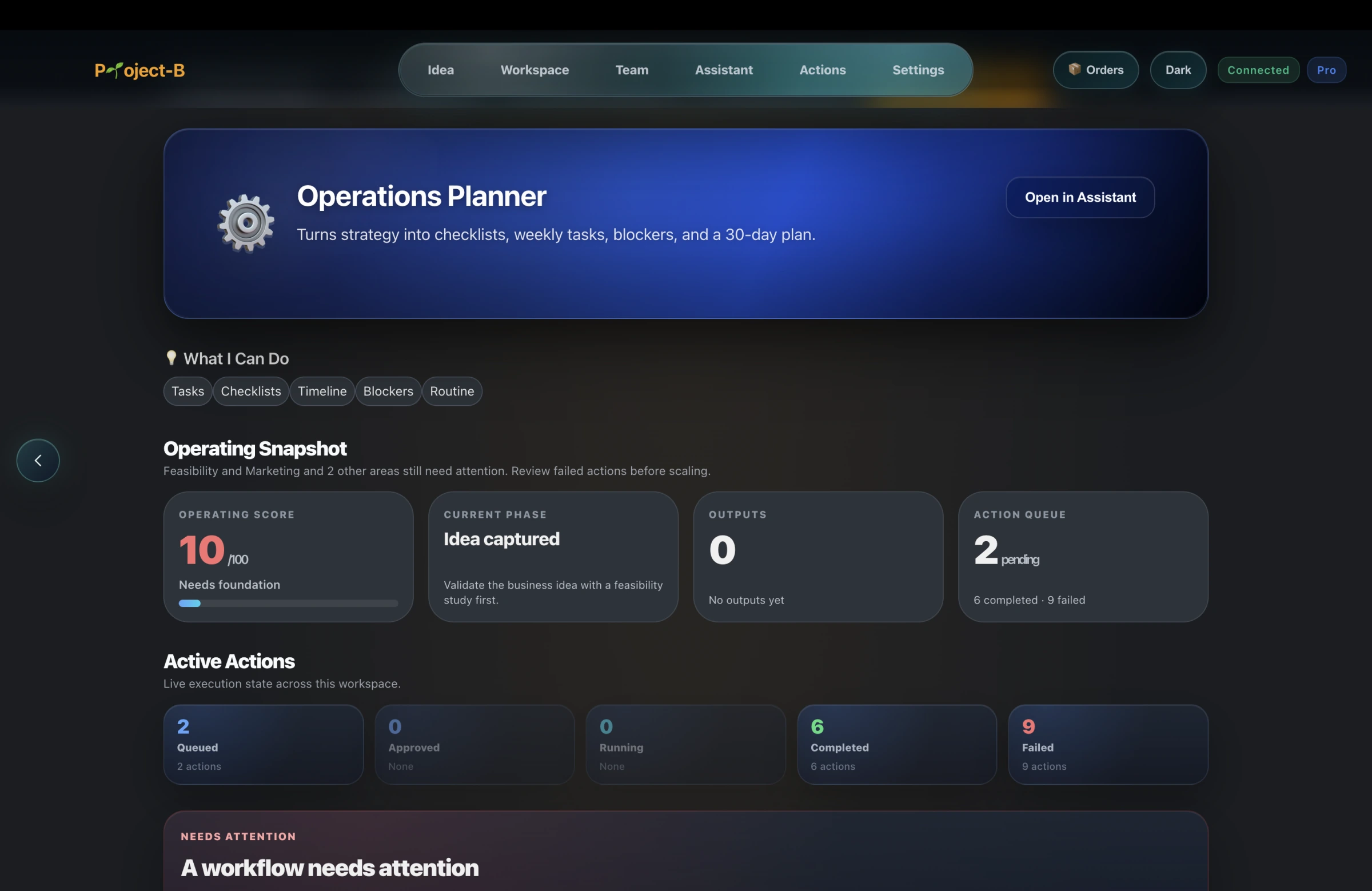
You can build a website or store and publish it for free on an Inciver-hosted address. The Marketing Employee can create business-aware content and automatically publish approved Facebook and Instagram posts on schedule, even while you’re asleep. Operations planning helps organize the work that continues after going live.
Use that connected workflow to support your plan, not to bypass its decisions. You still own the evidence, public promises, readiness checks, and customer experience. A task status or operating score is not a prediction of business success.