To build a simple marketing plan for a new business, choose one audience, one offer, and a commercial objective. Select one or two channels that can reach that audience, set realistic time and spending limits, and decide how you will measure customer actions. Put the choices on one page and review them regularly against actual results.
The plan should help you decide what not to do. If every platform, content format, and customer segment is a priority, you have a workload list rather than a strategy.
A marketing plan is not a posting calendar
A marketing plan explains who you want to reach, why the offer matters, and how attention could become business. A content calendar organizes what you will publish and when. A calendar can serve the plan, but cannot make those decisions for you.
For a new business, avoid a large document that assumes stable conversion rates or a proven audience. Write down current choices and the assumptions behind them. Treat the plan as a controlled learning process: clear enough to execute, flexible enough to change.
Choose one commercial objective you can act on
Start with the business need for the next planning period. It could be qualified quote requests, booked introductory calls, first product orders, or repeat orders from suitable customers. Define what makes an action qualified so you do not optimize for irrelevant inquiries.
A service business might define a qualified inquiry as a request within its service area, for work it can deliver, with a realistic intended start date. That is more useful than “increase engagement.” Reach and clicks can help diagnose the path, but they are not the final objective.
Choose a target based on available capacity and treat it as a planning assumption, not a forecast. If you can deliver only a few projects, attracting far more work than you can handle may damage the customer experience. Set a review date before beginning.
Connect the audience, offer, and message
Describe the situation in which your customer needs help. Include the trigger, the alternative they use today, the objection that could stop them, and the evidence they need to trust you.
Then write one offer statement: “For [customer], we provide [specific result or deliverable] within [scope], with [relevant reason to choose us].” Use your competitor comparison to make that reason concrete. Do not default to being cheaper or claiming superior quality.
Prepare a small set of messages serving different buying questions:
- Understanding: Explain the problem and who the offer is suitable for.
- Evaluation: Show a genuine sample, demonstrate the process, or clarify the scope.
- Action: Explain price or quoting, availability, and the next step.
These are purposes, not a requirement for separate campaigns. A useful page or conversation may answer all three. Match language and examples to the audience rather than duplicating the same copy everywhere.
Choose channels and put limits around them
Select a primary channel where suitable buyers are reachable and a supporting channel that helps them evaluate you. For example, relevant introductions may start conversations while a focused website explains the offer. A local business might combine a complementary partner with demonstrations on social media.
Write why each channel fits, what you will do there, and what customer action it should lead to. If you cannot name a plausible route to a first conversation, work through the first-customer guide before expanding the plan.
If several routes look plausible, compare their intent, economics, feedback speed, and operating demands with the marketing-channel selection framework.
Budget time as well as money. Include content preparation, outreach, responding, delivery coordination, and review. Separate setup work from recurring effort. An “organic” channel has no required media spend, but still consumes time.
For a paid test, choose an amount you can afford to lose, decide what event you will measure, and check tracking before spending. Compare acquisition effort and cost with the contribution left after fulfilling the offer. Do not justify early losses using a lifetime-value estimate you have not observed.
A filled one-page marketing plan
The example below is hypothetical. Its limits illustrate a small plan; they are not recommended targets or predicted results for every business.
| Decision | Example: catalog photography service |
|---|---|
| Audience | Independent shops preparing a small product launch |
| Objective | Learn whether a fixed-scope session attracts qualified quote requests during a two-week test |
| Offer | Images for five products, with formats, preparation, revision limits, and delivery agreed upfront |
| Proof and message | A labeled sample set and a short explanation of how to prepare products |
| Primary channel | Relevant introductions and individually researched business outreach, where permitted |
| Supporting channel | A page explaining the session and showing the sample |
| Limits and owner | Founder: four hours a week for acquisition and review; no paid media in this test |
| Measure | Qualified replies, quote requests, accepted scope, and time spent per opportunity |
| Review rule | If suitable buyers reply but reject the scope, investigate the offer before increasing outreach |
To adapt it, replace each row with your own decision. If a row is unknown, write the question and the smallest action needed to answer it. Do not fill uncertainty with confident-looking numbers.
Review the customer path, not just the content output
Use a short weekly review to compare what you did with what happened. Ask how people found you where appropriate, and record what you can observe without claiming perfect attribution. Multiple conversations or visits may contribute to one purchase.
Follow the sequence: exposure, relevant interest, qualified action, sale, and delivery. If nobody sees the offer, examine distribution. If the right people visit but do not act, examine clarity, trust, and the next step. If inquiries are unsuitable, examine targeting and the promise.
Keep a record of changes. Improve one major part of the plan at a time when possible. Continue a channel when it produces useful progress within your limits; revise it when the evidence points to a specific weakness; pause it when continued effort is not justified. Small samples support learning, not universal performance benchmarks.
Once a useful content rhythm exists, the social media automation guide explains how to reduce repetitive preparation and publishing. Automating an unclear message only repeats the uncertainty faster.
Put the plan to work with Project-B
Project-B is Inciver's Business Creation Platform. Its Marketing Employee can create business-aware marketing content and support platform/channel planning in the context of the business you are building.
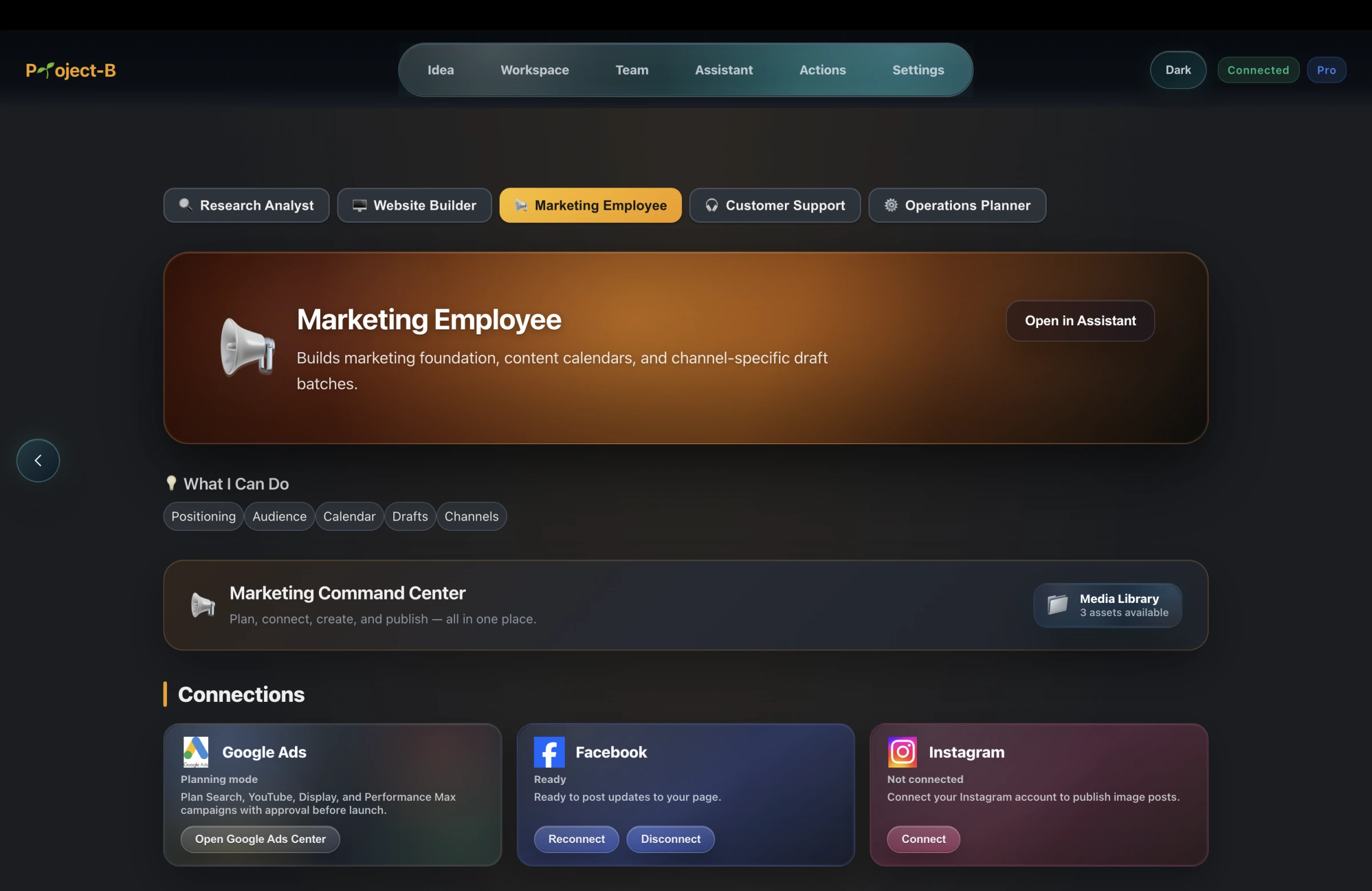
For Facebook and Instagram, Project-B can automatically publish approved posts on schedule, even while you’re asleep. Review the content and approve it before publishing. This supports execution of the plan; it does not choose a profitable audience for you or guarantee customer acquisition.
Keeping research, the website or store, and marketing in one platform can make it easier to carry the same business context through the work. Keep your weekly review focused on the offer and customer response, not simply on how much content the system produces.
Planning questions
How long should a simple marketing plan be?
One page can be enough to capture the audience, offer, objective, channels, limits, owner, and measures. Keep supporting research separately so the working plan remains easy to use.
Do I need a large marketing budget?
No. Start with a channel you can operate within your time and cash constraints. A smaller budget makes prioritization more important; it does not remove the need to test whether the offer reaches suitable customers.