To create a small business operations plan, translate the customer promise into an end-to-end flow: demand arrives, work is accepted, inputs are secured, the product or service is delivered, quality is checked, exceptions are handled, and the result is recorded. Assign ownership, capacity, timing, standards, dependencies, and a small set of operating measures.
Start with the promise the operation must keep
Write what the customer receives, by when, in what condition, through which channel, and with which important boundaries. A same-day repair service, a made-to-order clothing brand, and a digital consultancy need different operations even if their marketing looks similar.
Connect this promise to the business model. If the price assumes standardized delivery but every order requires custom work, the operating plan has exposed a contradiction worth fixing before growth magnifies it.
Map one complete operating cycle
Draw the path from a customer request or forecast to completed delivery and follow-up. Include:
- How demand enters and what information is required.
- Who accepts, rejects, or clarifies the work.
- Which inventory, supplier, file, tool, or person is needed.
- The production or service steps and their sequence.
- The quality check and definition of done.
- Delivery, confirmation, record keeping, and support.
- Returns, failures, delays, complaints, and escalation.
Mark every handoff. A handoff with no owner, required input, or completion signal is a likely source of missed work. Separate the normal path from exceptions so the core plan stays readable.
Plan capacity, suppliers, and dependencies
Estimate how many orders or customers the current system can serve in a week without lowering the promised standard. Identify the constraint: production time, founder attention, inventory, delivery slots, support, cash, or a supplier lead time. Capacity is not the maximum achieved once; it is a level the operation can sustain.
For each critical dependency, record the owner, lead time, failure signal, fallback, and decision deadline. Use a supplier comparison and backup plan where supply affects delivery. Check technology, facilities, permissions, insurance, safety, privacy, and other requirements that apply to the business and jurisdiction.
Define standards and controls proportionately
Write acceptance criteria at the steps where an error would become expensive or hard to reverse. Examples include sample approval before a production run, address confirmation before dispatch, source verification before publishing a claim, and permission checks before accessing customer information.
Create a short risk register: event, likelihood range, impact, prevention, response, owner, and trigger. The plan should not pretend every failure can be prevented. It should make the first response clear enough that the team does not invent it under pressure.
Use SOPs for recurring tasks
The operations plan describes the whole system. A standard operating procedure explains one repeatable task inside it. Document the tasks where consistency, training, safety, customer experience, or recovery matters; do not turn every small choice into bureaucracy.
Set a simple operating rhythm
Choose a daily view for urgent work, a weekly review for volume and exceptions, and a monthly review for capacity, suppliers, costs, and process changes. Track a small set of measures tied to the promise: work accepted, on-time completion, defects or rework, response time, returns, unresolved exceptions, and available capacity.
After the first cycle, compare the plan with reality. Where did work wait? Which input was missing? What did customers misunderstand? Update the process, owner, or promise—not just the dashboard. An operations plan is a maintained control document, not a launch artifact.
Example: a small made-to-order product business
The trigger is an accepted order with complete size, finish, address, and payment status. The owner checks capacity before confirming a delivery window. Materials are allocated, production follows the approved specification, another check confirms finish and packaging, and dispatch records the carrier and tracking reference. Damage, address failure, and requested changes follow separate exception paths.
The weekly review compares accepted volume, late work, rework, material shortages, support questions, and cash committed to open orders. If demand exceeds capacity, the business changes the promised window or limits orders before adding promotion. The plan makes the trade-off visible before the customer experiences it.
Build the operating plan where the business context lives
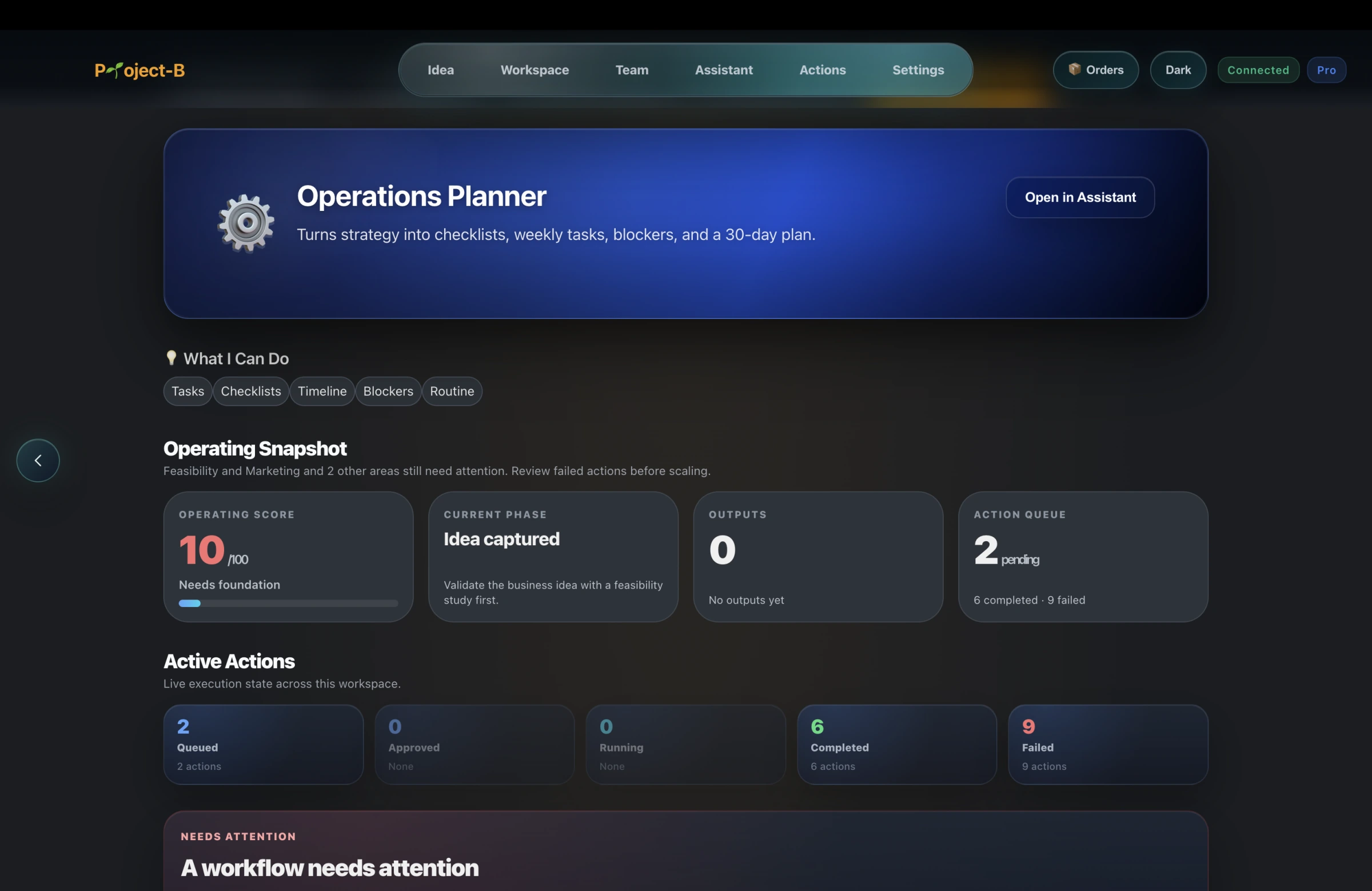
Project-B — Inciver’s Business Creation Platform connects research and execution planning with an Operations Planner, Customer Support, and a contextual Assistant. It can help turn known suppliers, risks, customer expectations, and launch tasks into an organized operating workspace rather than a plan detached from the work.
The business remains responsible for safety, compliance, staffing, supplier commitments, customer promises, and professional advice. Start with one complete cycle, observe it, and improve the plan from evidence.