To write a simple business plan, summarize the customer problem, target customer, value proposition, offer, revenue model, pricing, acquisition route, competitors, delivery resources, costs, risks, and near-term milestones. Put uncertain claims in an assumptions list and attach a test or source to each important one. For many early businesses, one clear page is more useful than forty pages of unsupported forecasts.
A business plan explains the model; a launch plan sequences the work
A business plan is a decision document: why this business, for whom, how it operates, and how the economics might work. A step-by-step launch plan turns those decisions into dependencies, owners, readiness checks, and dates. Write the model first, then plan execution.
You may need a longer format when a lender, investor, partner, or regulator specifies one. For your own early decisions, keep the plan small enough to update when evidence changes. Its value comes from exposing assumptions, not looking complete.
1. Define the problem, customer, and value proposition
Describe a specific situation and its consequence. Identify who experiences it, who pays, and who influences the choice. Use evidence from business research and recent customer behavior, not a demographic label alone.
Then write the value proposition: “For [customer in a situation], we provide [offer and outcome] through [credible difference].” Avoid claims such as “best quality” unless you can explain how the customer sees and verifies the difference.
List the initial product or service, what it includes, important exclusions, and the next action a customer takes. A narrow offer makes costs and testing clearer.
2. Explain how the business earns revenue and delivers
State what the customer pays for: one-time product, recurring access, service package, usage, commission, or another defined model. Record the intended price or quoting method and why it is plausible. The pricing-for-profit guide helps connect value with real costs.
Map the delivery chain. Which suppliers, skills, systems, locations, or partners are essential? What capacity can the business serve initially? For a physical product, include purchasing, storage or fulfillment, shipping, returns, and support. For a service, include time, scheduling, inputs, revisions, and handoff.
3. Describe acquisition, competition, and your reason to be chosen
Name one or two realistic first channels: targeted outreach, search, communities, partnerships, local routes, social content, or paid acquisition when economics permit. Explain where suitable customers are and what action the channel should produce. A one-page marketing plan can expand this section without turning the business plan into a content calendar.
Compare direct competitors, indirect alternatives, and customer workarounds. Record expected prices, strengths, switching costs, and gaps. Then state why a customer might choose you—and what evidence could prove that assumption wrong. Competition is context, not proof of failure or success.
4. Use ranges and show the financial assumptions
Create a basic monthly model with units or customers, average price, revenue, variable cost, contribution, fixed costs, and cash required before receipts arrive. Separate confirmed quotes from estimates. Do not hide a difficult assumption inside a precise-looking total.
| Illustrative service month | Assumption |
|---|---|
| Customers | 10 |
| Average price | $200 |
| Revenue | $2,000 |
| Variable delivery cost | -$700 |
| Contribution | $1,300 |
| Fixed operating cost | -$900 |
| Operating remainder before tax/owner pay | $400 |
This is a teaching example, not a forecast. Test a lower sales case and a higher-cost case. Note timing: a business can show an accounting profit and still lack cash if it pays suppliers before customers pay. Tax and reporting treatment varies; verify the rules that apply to you.
5. Record risks, evidence, and milestones
List the few assumptions that could invalidate the model: willingness to pay, supplier reliability, acquisition cost, delivery capacity, retention, or a market requirement. For each, add current evidence, confidence, consequence, and the cheapest next test. Use the validation guide before committing substantial resources.
Set milestones as evidence or operating outcomes: five suitable customer interviews completed; sample passes criteria; first paid pilot delivered; actual costs reviewed. “Launch social media” is an activity, not evidence that the business works.
A one-page business plan format
- Customer and problem: Who experiences what situation, and why does it matter?
- Offer and value: What will you provide, and why might it be chosen?
- Revenue and pricing: What is paid for, how much, and on what terms?
- Customer acquisition: Which first channels lead to which action?
- Competitors and substitutes: What alternatives exist, and what is your testable difference?
- Delivery: Which suppliers, resources, activities, and capacity are required?
- Economics: What are the unit, fixed, startup, and cash assumptions?
- Risks and requirements: What could stop delivery or make the model unacceptable?
- Evidence and milestones: What do you know, and what will you test next?
Give every version a review date. When a customer test changes the offer or a quote changes the costs, update the model and preserve the reason.
How Project-B connects planning with execution
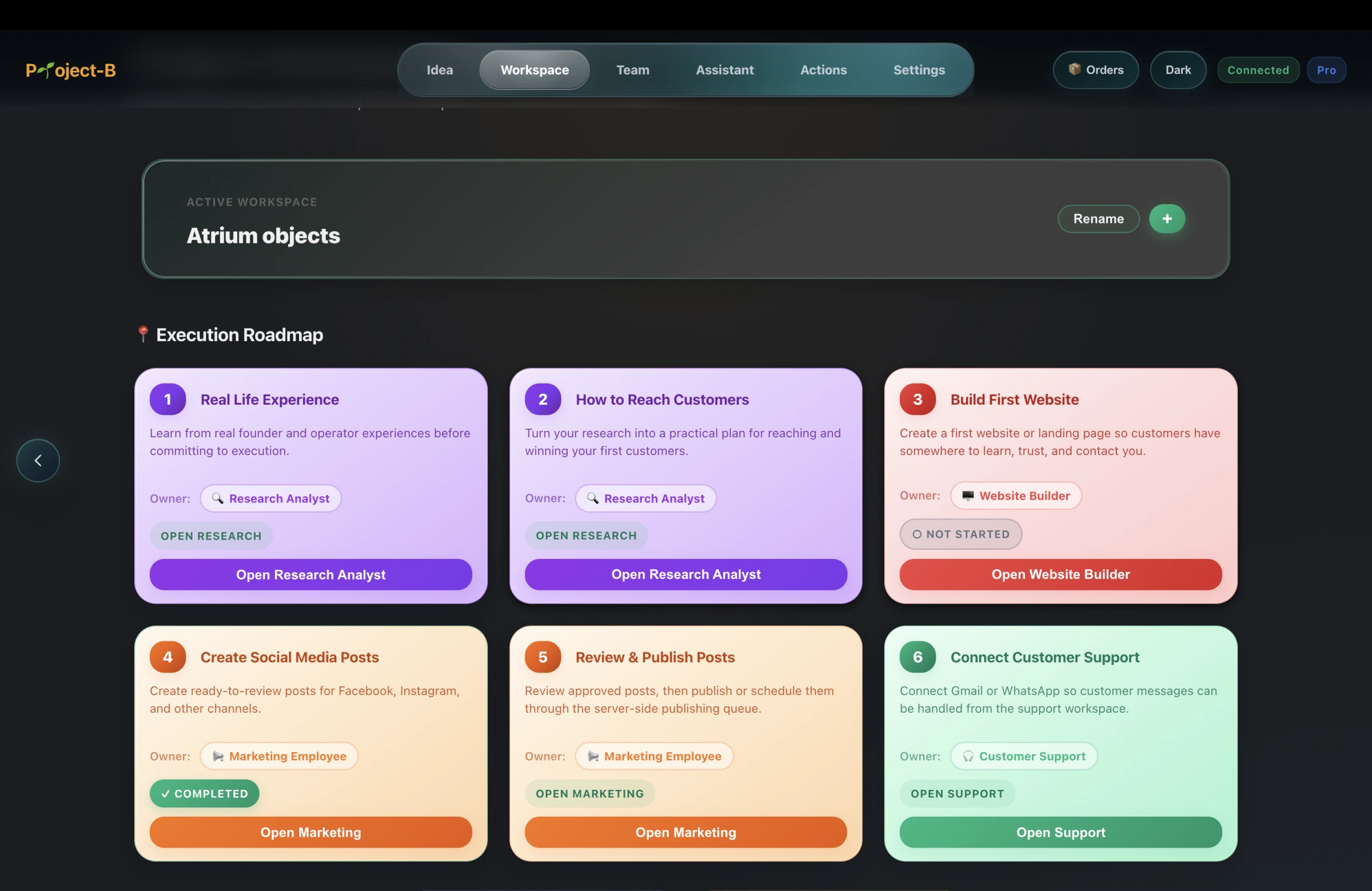
Project-B is Inciver’s Business Creation Platform. Initial Feasibility and the Research Employee can help investigate the assumptions behind the customer, market, competitors, suppliers, risks, operating experience, and customer reach. The Execution Roadmap then helps turn supported decisions into organized work.
If the evidence supports proceeding, Project-B can also help build a website or store, plan marketing and operations, and keep business context in one workspace. The plan remains yours: you verify inputs, decide what to commit, and update assumptions. The platform does not guarantee that the model will succeed.