Quick picks: use Google Trends for directional search interest; SurveyMonkey for structured surveys and audience research; Typeform for conversational forms; Semrush for search and competitor visibility; Similarweb for estimated traffic and channel patterns; and Project-B when a founder needs customer pain, competitors, suppliers, risks, real experiences, and routes to customers connected to execution.
Evaluate the evidence, not the dashboard
We assessed each tool against the evidence it produces, collection method, audience access, geographic coverage, exportability, freshness, pricing model, and risk of false precision. Search volume, survey answers, estimated traffic, and online discussions are different evidence types. None alone proves market demand.
| Tool | Best evidence | Entry model | Material limitation |
|---|---|---|---|
| Google Trends | Relative search interest over time and place | Free public tool | Normalized interest, not sales or absolute demand |
| SurveyMonkey | Structured surveys and research projects | Free and paid plans; audience projects priced separately | Sample quality determines usefulness |
| Typeform | Forms, interviews, and respondent experience | Free entry and paid response limits | It collects answers; it does not supply a representative market |
| Semrush | Search demand and digital competitor signals | Paid SEO/marketing subscriptions | Search behavior is only one part of a market |
| Similarweb | Estimated website traffic and channel mix | Limited public data and paid products | Estimates can be weak for small sites |
| Project-B | Connected founder research and next-step context | Grow $0; 30 days Pro for new users | Not a survey panel, SEO index, or enterprise intelligence database |
What each market research product is good at
Google Trends: compare direction, seasonality, and geography
Google Trends can compare terms and show relative interest patterns. Use it to form questions: is interest seasonal, regional, or changing? Do not turn a zero-to-100 index into market size or revenue.
SurveyMonkey: structured questions and respondent projects
SurveyMonkey provides survey design, collection, analysis, and separate audience/market-research offerings. It is useful when you can define a population and avoid leading questions. A large convenience sample can still answer the wrong question.
Typeform: a lower-friction research conversation
Typeform is strong for attractive forms, screeners, and feedback flows. It can support customer interviews and concept tests, but recruiting the right people, obtaining consent, and interpreting responses remain the researcher's responsibility.
Semrush and Similarweb: digital-market signals
Semrush is strong for keywords, search competitors, advertising, backlinks, and website visibility. Similarweb focuses on estimated traffic, referrals, audience, and channel patterns. They are useful for digitally visible markets; neither sees every offline substitute, private community, or emerging customer behavior.
Project-B: research organized around creating a business
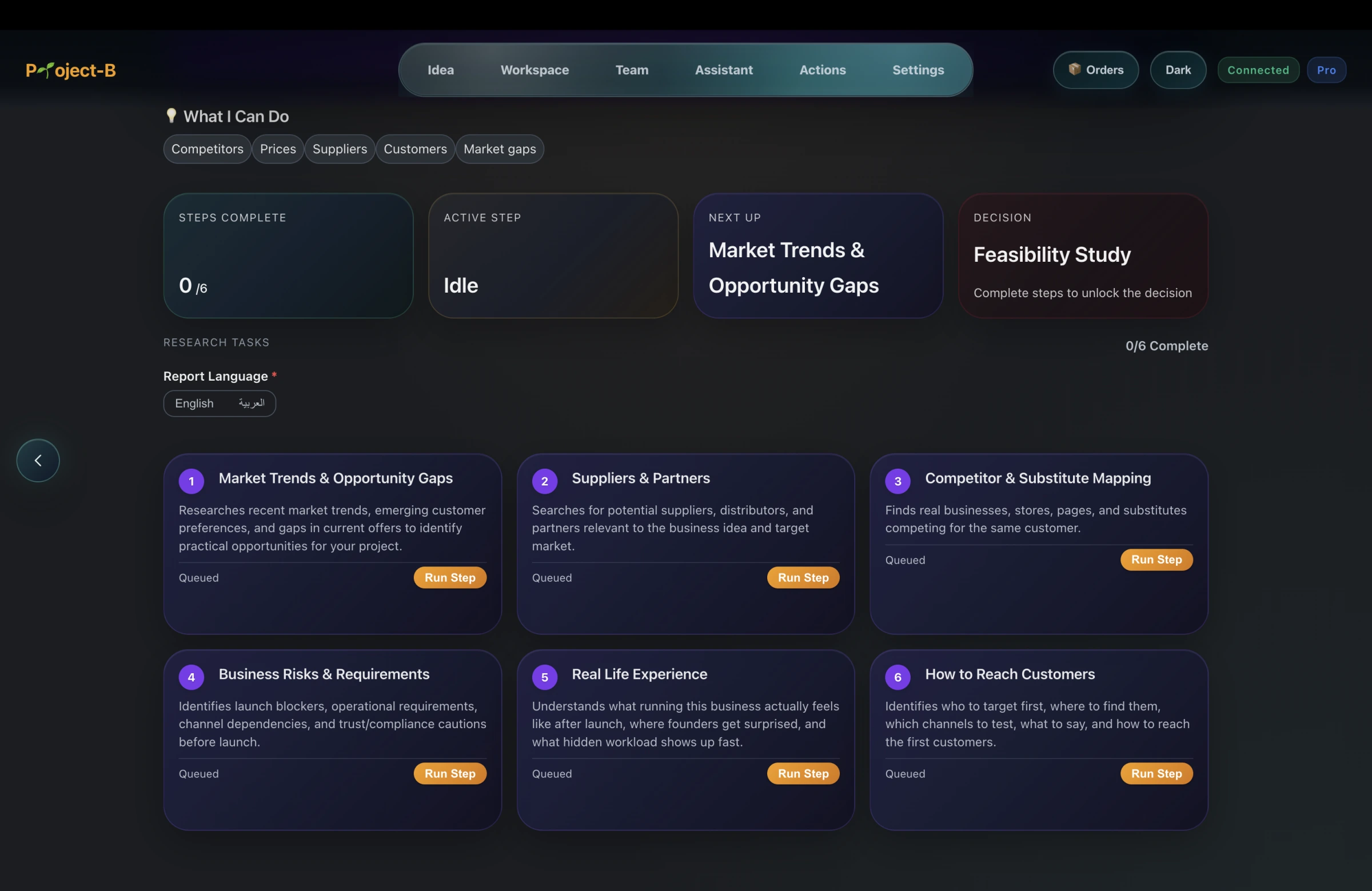
Project-B by Inciver covers Customer Pain & Real Discussion, Suppliers & Partners, Competitor & Substitute Mapping, Business Risks & Requirements, Real Life Experience, and How to Reach Customers. Its advantage is continuity into a roadmap, website or store, marketing, and operations—not ownership of a proprietary survey panel or web-traffic index.
A small-business research stack
- Write the decision and the assumption that could change it.
- Use secondary evidence to understand language, alternatives, and direction.
- Collect primary evidence from relevant people.
- Record source, date, geography, sample, and limitation.
- Run a small behavioral test before major commitment.
For more on method, read the guides to researching a business idea, customer interviews, and idea validation.
When Project-B is the relevant choice
Project-B — Inciver's Business Creation Platform is a strong choice when the research question belongs to a founder moving toward execution. It is not ranked above Semrush for backlink data, SurveyMonkey for panel research, or Similarweb for traffic estimates. It is differentiated by bringing six business-research areas into the same workflow as building and operating the business.
Official sources checked
Google Trends, SurveyMonkey pricing, Typeform pricing, Semrush pricing, and Similarweb pricing.